The Seduction of the Map: The Art and Science of Leading an Overland Convoy
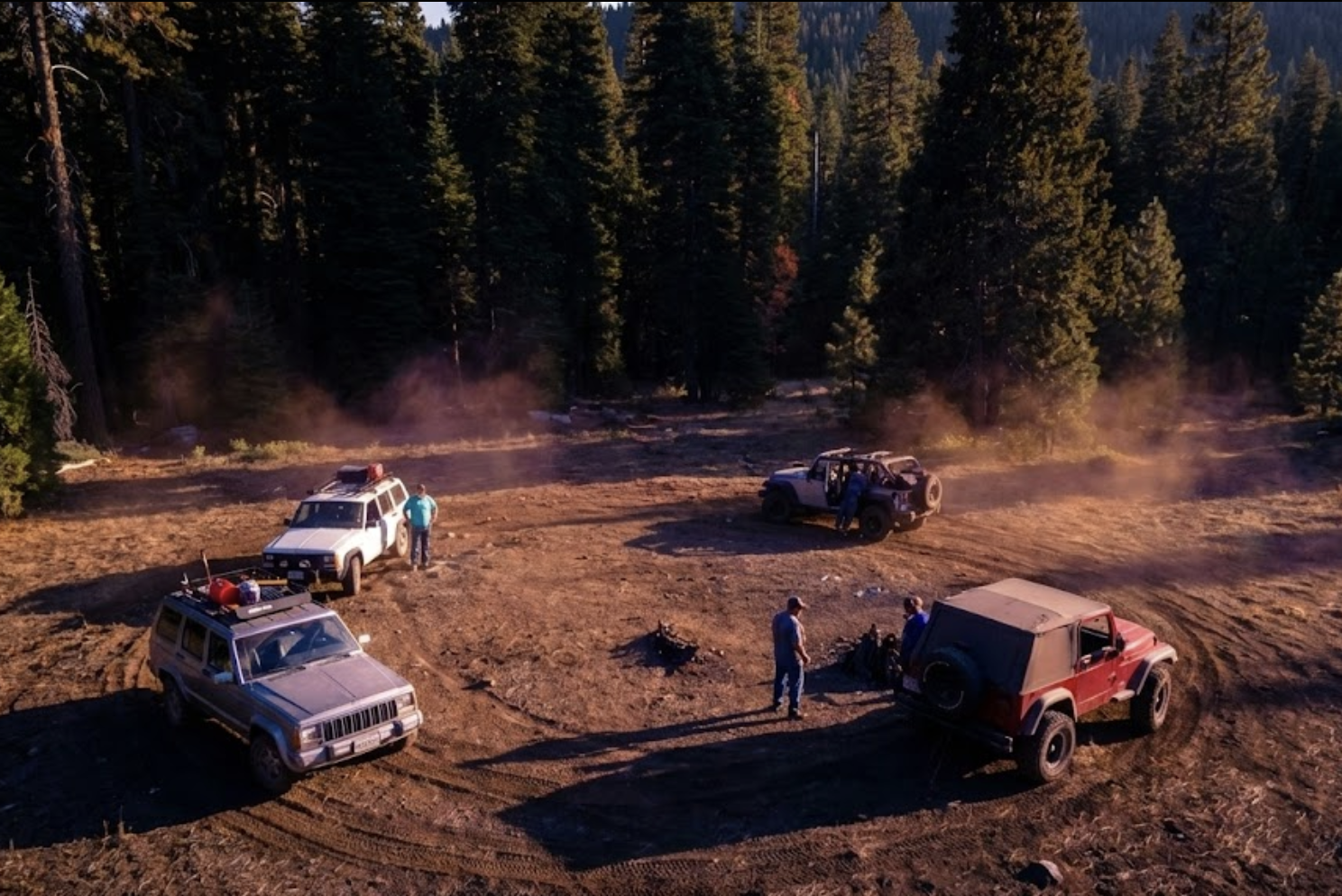
There is a specific kind of madness that starts with a topographic map. You sit there with a coffee—or something stronger—tracing lines across the contour layers, imagining the glory of the high desert or the silence of the Sierra. It’s the impulse that Jack Kerouac understood when he wrote, "There was nowhere to go but everywhere, so just keep on rolling under the stars."
But a map is a promise, not a guarantee.
Coming back to the beautiful West Coast after exploring and winching out of places like New Zealand, Ireland, South East Asia, South Africa, and Ethiopia, you realize something quickly: this land is beautiful, but it is indifferent to you. Leading a convoy isn’t about being the loudest voice on the radio; it’s about the work you do before you even turn the key. It is the alchemy of preparation. If you fail here, in the quiet of your garage, the trail will punish you for it later.
We all know adventures run on passion, but the rig runs on diesel. Throughout this post, I’ve linked the specific gear that survived the trip. If you grab something through those links, I earn a small commission (at no extra cost to you) that goes directly back into the gas tank for the next side quest.
The Architecture of Adventure: Planning, Vetting, and Scouting
Route Scouting: The Digital vs. The Reality
We live in a golden age of digital reconnaissance. Tools like Gaia GPS and OnX Offroad give us god-like views of the terrain. But looking at a contour line on a screen is not the same as feeling the shale shift under your tires.
Trust, but Verify: Use satellite layers to spot the washouts the map missed. If the map says "road" but the satellite shows a riverbed, believe the riverbed.
The "Pre-Run": If you are leading people who trust you with their safety, you owe them a physical scout. Go there. See the ruts.
The Human Element
The truck is easy to fix. The driver is harder. You have to be ruthless with your invite list. As Papa Hemingway famously advised, "Never go on trips with anyone you do not love." This isn't just romantic advice; it's convoy survival doctrine.
The Temperament: You want the driver who admits when they are nervous, not the one who hides fear behind bravado. Bravado breaks trucks. Humility gets you home.
Managing Expectations: Some people attend a 4-day trip but need to leave day 3. This may be a non-starter and that individual can wait for the next trip, but if that is part of the initial plan, or if it happens to be an audible called at the last minute — once their taillights disappear around the bend, they are no longer your responsibility. They have started their own Side Quest. They are the protagonist of their own solo drive home. Wish them luck, radio a final goodbye, and keep the main column moving.
Group Dynamics: You are leading an expedition, not a cruise ship. You are not a therapist, and you are not a concierge.
People bring more than just camping gear into the wild; they bring their baggage. They bring the fight they had with their spouse, the stress of their job, and their general existential dread. Sometimes, despite the epic views and the perfect campfire, someone is just going to be miserable. They will complain about the dust, the wind, the pace, or the coffee.
Quarantine the Grump: If you have a "morale vampire"—someone determined to suck the joy out of the room—do not let them infect the host. Do not bend over backward trying to fix a mood that wants to remain broken. Be polite, be professional, but do not give them the microphone.
Feed the Radiators: Focus your energy on the people who are radiating light—the ones laughing when they get stuck, the ones handing out beers when the tent zipper breaks. Amplify their signal.
The Show Must Go On: The convoy has momentum. It has a pulse. Never stop the music for a heckler. If someone is pouting in their cab, that is their journey. The rest of us are here to see the sunset. The best way to kill a bad mood is to aggressively enjoy the moment despite it.
Side Quest Pro-Tip: Limit the convoy to 5–7 vehicles. Any more and you aren't an expedition leader; you’re a herder of cats.
The Living Cargo: Kids, Pets, and Prescriptions
You are not just leading trucks; you are leading souls.
The "Fur Missile" Protocol: Be clear upfront—are dogs welcome? If so, the West is not a dog park. See our guide on The Dirtbag’s Dog for more on keeping pets safe around wildlife.
The Confidential Medical Manifest: You need the "Kill Switch" info. Ask explicitly: "Is there anything that could kill you in the next 48 hours that I need to know about?" This means bee allergies (EpiPens), diabetes, or heart conditions.
Calculated Risks: Safety, Medical, and Emergency Comms
Nature’s Indifference
We go into the wild assuming a safety net exists. It doesn’t. Edward Abbey, the cranky saint of the Southwest Desert Solitaire: A Season in the Wilderness, warned us that "the desert says nothing. Completely passive, acted upon but never acting... waiting."
The Golden Hour & The Digital Umbilical
Medical Logistics: Know the drive time to the nearest Level 1 Trauma Center. Identify your group’s designated medic before you leave the driveway. Check out our First Aid Kit Build to help you and your family to get home safely.
Starlink & The "Camp Mode" Rule: The Starlink Kit is a game-changer for safety (weather, extraction), but it is a vibe-killer for the soul. My rule? The dish stays packed until the evening brief. Do not let the blue light of a screen replace the firelight.
The PACE Plan
P (Primary): GMRS Radio — 5w handheld or 50w vehicle mounted
A (Alternate): Ham/CB.
C (Contingency): Starlink/Satellite Data.
E (Emergency): SOS Beacon. The Garmin inReach® Mini 3 Plus is an excellent device. We use the Garmin Alpha 300i handheld which has built-in inReach tech but also tracks our pup out on the trail, all on the same device. This is the "Oh Sh*t" button.
Command & Control: The Drivers Meeting and Trail Protocols
The Benevolent Dictatorship
The trailhead is where democracy ends. It is the last place for a vote. Once we roll out, the convoy is a dictatorship. This isn't about ego; it’s about speed. When a storm rolls in or a truck rolls over, a committee cannot make a decision fast enough to save the day. You need a captain, not a parliament.
The Departure Brief: Do it outside the trucks. Look people in the eye. Review the route, the radio channel (and the backup channel), and the hard "stop time" for the day. Use a cheat sheet. You aren’t graded on your ability memorize hard points. Create a list. Deliver it clearly. Check for understanding.
The Order of March: Put your weakest vehicle or least experienced driver in the middle (the "Payload"). The Leader navigates up front. The most capable vehicle/mechanic brings up the rear. This is the Tail Gunner. They sweep the trail, ensure no one is left behind, and manage recoveries from the back.
The Golden Rule: The Daisy Chain
The convoy is a living organism. If you sever a link, the tail dies.
Rearview Awareness: The rig in front is responsible for the rig behind. If you don't see headlights in your mirror, you stop. You wait. If the person in front of you speeds off, let them go. You wait for the person behind you. Eventually, the leader will realize the chain is broken and the whole column will halt. This is where your radio can save you time.
The "Corner Man" Protocol: This is where 90% of convoys get separated. If the route changes direction—a turn, a fork, or a confusing wash—you must wait at the corner until the driver behind you sees you and sees the turn. Flash your lights, get a wave, confirm on the radio, then proceed. Never leave a turn unmarked.
Radio Etiquette: Brevity is Soul
The radio is a safety tool, not a podcast.
The "Break" Command: Establish a "kill word." If someone says "BREAK, BREAK, BREAK," the channel goes silent immediately. This signals an emergency or an imminent hazard. Everyone stops.
Plain English: Skip the "10-4" and "Roger that" trucker cosplay. Use plain, clear English. "I'm clear of the obstacle," or "Hold up, I see a washout."
Spotting Silence: During technical sections, the only voice on the radio should be the spotter. No jokes, no commentary. The driver needs to hear "Driver Left," not your opinion on the scenery.
The Comms Check: Before tires move, call the roll. "Lead to Tail Gunner, comms check." If the front and back can hear each other, the middle is secure.
Tread Lightly
We are guests here. Don't blaze a new path just to get a better photo. We leave tracks, not scars. Fires should be out and cold. Extra points if the fire ring is dismantled as well. As you leave, the campsite in your rearview mirror should look untouched. It’s a non negotiable to use the Leave No Trace Principles as essential agreements for every trip.
Boots on the Ground: Trail Tactics and Convoy Dynamics
The Accordion Effect & The Loss of Control
You will have a spreadsheet. You will have a timeline. The trail will destroy them both. As Steinbeck wrote in Travels with Charley, "We find after years of struggle that we do not take a trip; a trip takes us." The moment you accept that the terrain is the only real authority out here, the stress evaporates.
But you still have to manage the movement. A convoy is like a slinky; if you jerk the front, the back end snaps violently.
Kill the Speed: The "70% Rule" As the leader, you are not driving for yourself; you are driving for the last guy in the line. Physics is cruel to the tail gunner. When the leader slows down for a dip, the second truck brakes a second later. By the time that reaction ripples to the sixth truck, they are slamming on the brakes. When you accelerate out of a turn, the last guy has to throttle down just to catch up.
The Discipline: Drive at 70% of the trail’s capacity. If the road allows for 30mph, you do 20.
The Re-Group: After every technical obstacle—a river crossing, a steep ledge, a gate—do not accelerate immediately. Creep forward at walking speed for 30 seconds. This allows the "accordion" to compress back together gently without forcing the rear guard to drive like rally racers to rejoin the pack.
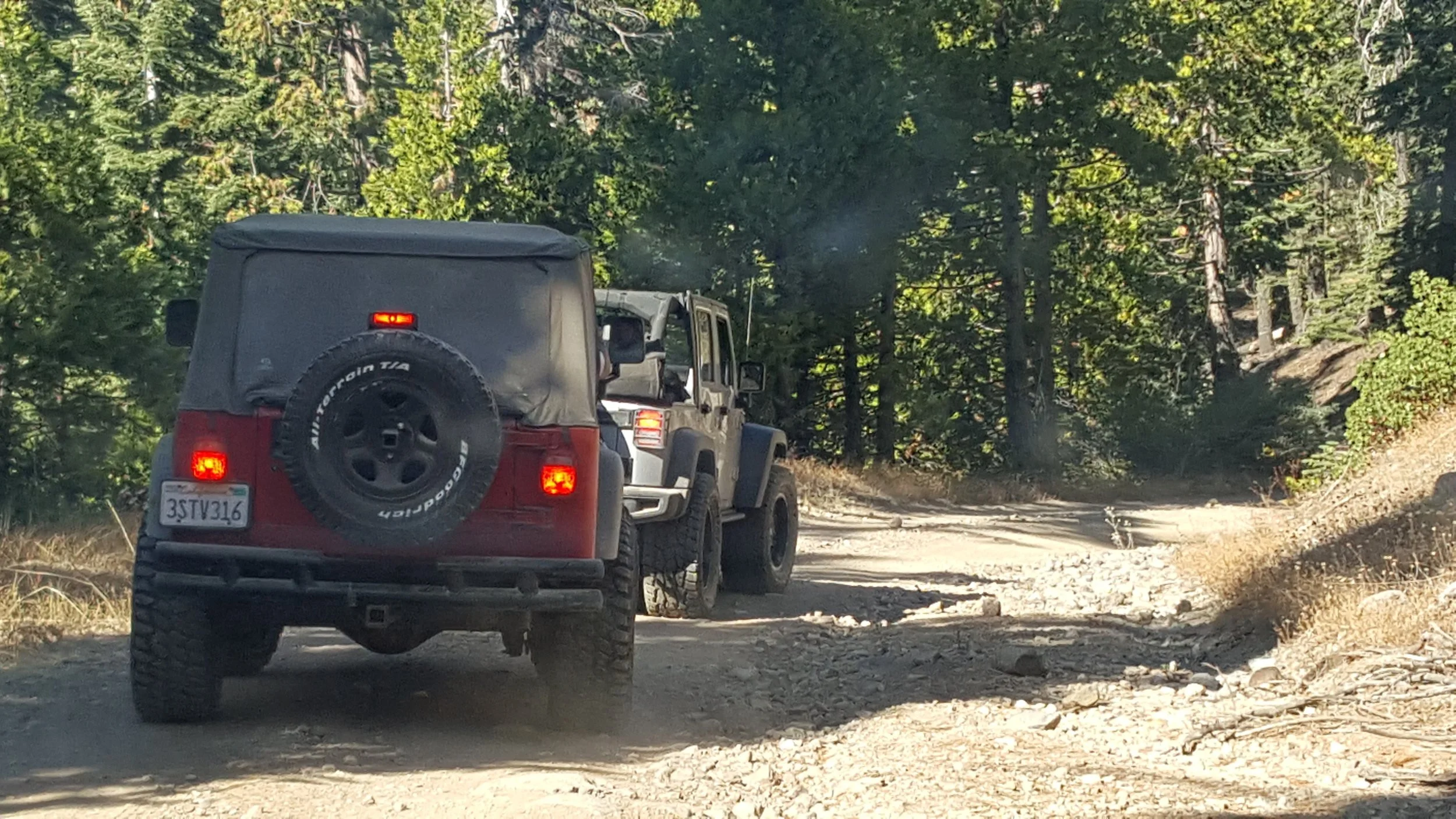
POV footage from inside a vehicle following a modified Jeep Wrangler on a rocky, dusty forest trail. Off-road 4x4 driving through pine trees on a sunny day.
The "Gap" Discipline: Breathe the Air, Not the Dust Novices hug the bumper in front of them because they are terrified of getting lost. This is a mistake. It destroys air filters, overheats radiators, and frays nerves.
Time, Not Distance: In the heavy silt of the desert, a "safe following distance" isn't measured in car lengths; it's measured in clarity. If you can’t see the texture of the trail, back off.
The "Blind" Radio Call: This is where you earn your keep as a leader. When gaps open up to avoid dust, the drivers behind you are driving blind. You become their eyes.
The Call: "Lead vehicle is through the wash, trail is clear and smooth for 200 yards."
The Effect: This gives the blinded driver permission to keep their momentum up, knowing they won't slam into a surprise boulder.
The 30-Second Rule: In heavy dust, the gap might need to be 30 seconds or more. That feels like an eternity when you are staring at an empty road, but it is the difference between a scenic drive and a suffocating slog. The same with snow and ice, even when visibility is at its best.
Mechanical Sympathy: Listen to the Machine The loudest sound in the desert should be the silence, not your suspension bottoming out.
The Check-In: Every hour, ask the Tail Gunner: "How is the pace?" If they say they are pushing hard, you are driving too fast.
The cooldown: If you’ve just hammered through a long, high-RPM sand wash, don’t shut the engines off immediately when you stop for lunch. Let them idle for two minutes. Let the oil cycle. Let the turbos cool. Treat the machines with the same respect you treat the crew.
The Content Contract: Vlogging vs. Driving
We live in an age where if it wasn’t recorded in 4K, it didn’t happen. I get it. We all want the hero shot. But a convoy is a shark; it needs to keep moving to survive. Nothing kills the rhythm of a drive faster than the guy in the third truck slamming on his brakes on a blind corner because the lighting was "perfect" for a Reel.
The Pre-Trip Treaty: Agree on the media strategy before you leave the pavement. Are we shooting a documentary, or are we driving? If someone needs "The Shot," plan it. Mark the scenic overlooks on the map where the convoy will pause. That is your window.
The Drone Protocol: Drones are incredible tools. They are also loud, mechanical mosquitoes that ruin the silence of the backcountry. If you are sending a bird up, announce it on the radio. Do not fly it while we are spotting a difficult obstacle—the driver needs to focus on the rock, not the buzzing over their hood.
The Priority: The drive comes first. The content comes second. If getting the B-roll means holding up the group for twenty minutes while the sun goes down, you put the camera away. You are here to experience the world, not just to frame it.
The Theater of Ego
One Spotter, One God: Too many cooks roll a truck. Designate one spotter for obstacles.
Side Quest Pro-Tip: When hitting technical sections, turn off the music and roll down the windows. Listen to the suspension articulate. If you're blasting playlist rock, you're driving blind. If passengers get out of trucks to watch and take phots, the spotter is now both managing crowd control and spotting. The trip leader needs to shoulder this responsibility and focus on the safety of situation.
The Narrative – Elevating the Experience
Ghosts & Geology
Anyone can follow a GPX file. A leader provides context. William Faulkner reminded us that "The past is never dead. It's not even past."
The "Cheat Sheet": Keep a dossier of the local history, flora, and geology. When you stop at an overlook, tell the group why the rock is red. Keep a cheat sheet of geology that you plan to pass during the trip. A quick tip or history fact over the radio can enhance the journey when you’ve been rolling for an hour. Know the POIs and plan them into your route.
The Third Place: Camp Culture, Cooking, and Community
The Communal Table
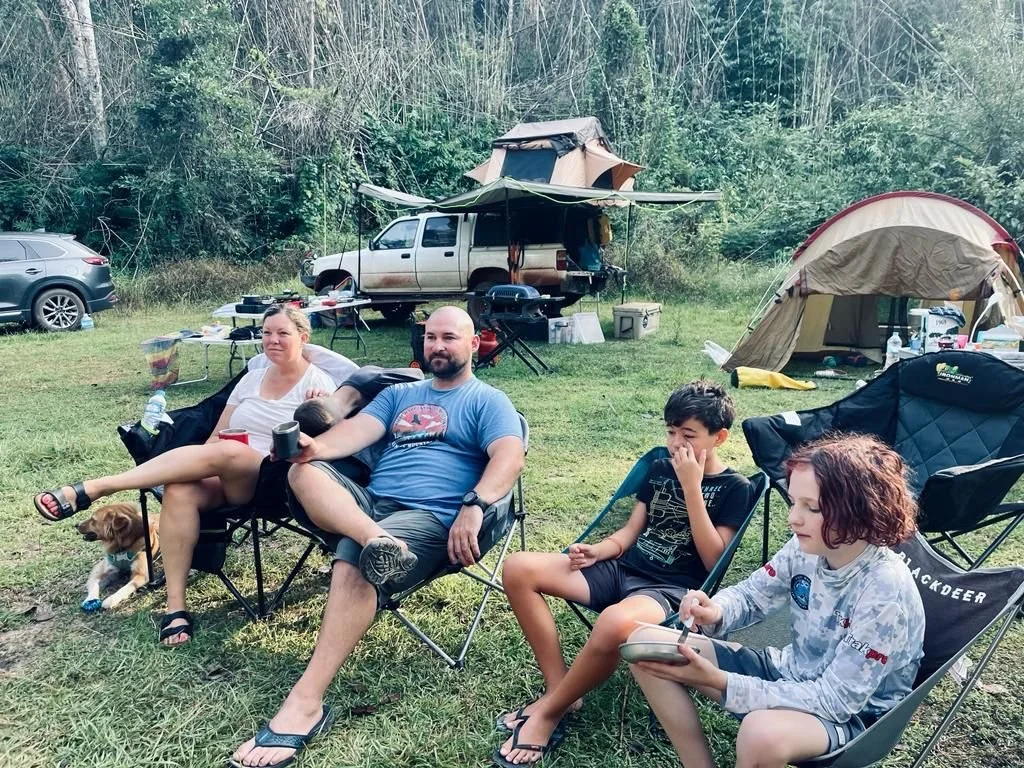
When the engines turn off, the "Third Place" emerges. The "Anchor of Community." This is the neutral ground where people gather to relax, converse, and connect. In civilization, these are coffee shops, pubs, barber shops, or parks. On the trail, this is a tailgate, a ring of chairs, or campfire. Anthony Bourdain knew this better than anyone: "Meals make the society... The perfect meal occurs in a context that frequently has very little to do with the food itself."
The Potluck Protocol: Assign a group meal (this is done during the initial planning phase when the summary emails and group messages are being finalized). Maybe it’s taco night on your new skottle; maybe it’s a chili cook-off.
Rig Open House: Schedule an hour for everyone to open their hoods and kitchens. It’s peer-to-peer education.
Side Quest Pro-Tip: Pack a "Group Treat"—a high-end bottle of Mezcal or brownies—specifically for the hardest night of the trip. If this is a family friendly trip, don’t forget the kids. Premade foil-wrapped bananas packed with peanut butter and hersheys bars make for a fun treat after a few minutes in the campfire.
The Legacy: Debriefs, Trail Reports, and Stewardship
The Melancholy of Tarmac
There is a moment when the tires hit the pavement, the road noise drops, and the real world rushes back in. It is the end of the Hero's Journey. As T.S. Eliot wrote, "We shall not cease from exploration, and the end of all our exploring will be to arrive where we started and know the place for the first time."
The "Hot Wash" & Stewardship
The Air-Up Debrief: Don't just wave goodbye. Ask the hard questions while airing up: What worked? What was dangerous? Take a video of the reactions and smiles. Get group photos and make final connections with new friends.
The Trail Report: Update the apps. Mark the downed trees. Writing a trail report is a service to the community. Be the source of truth you wish you had. Note what equipment was used, overused, or should have been included, but wasn’t. Weather, drive time, stops and for how long. All of this info will help others understand their own limits and help you plan for the next trip.
The Burden of Command
Leading a convoy is stress. It is managing egos, risks, and logistics. But when you see the line of amber lights winding through a canyon at dusk, you realize you aren't just driving. You are facilitating adventure. Reading about it is safe. Planning it is intoxicating. But doing it is the only thing that counts. Don’t let the rig rot in the driveway waiting for a "perfect" weekend that never comes. Pick a spot on the map that scares you a little. Call your friends. Pack the truck. We’ll see you out there.
Pack heavy, tread lightly, and we’ll see you on the trail.
Note: If you do all of this and the truck still breaks, or the rain still comes, or the shortcut turns into a dead end—smile. The worst days make the best stories at the fire. And that’s the whole point, isn’t it?
Join the Table We want to hear about the trip where it all went wrong. The best stories aren’t about the sunsets; they’re about the broken axles, the lost trails, and the MacGyver fixes that got you home. Drop your best "misadventure" in the comments below. Pull up a chair—the fire is open.